Role
Product Designer
Timeline
4 months
Team
5 Designers + 1 PM

Outcome Overview
VisitWell is a 0→1 healthcare app aimed at reducing harm caused by language barriers for underserved patients.
Problem Space
Language barriers make healthcare confusing, unsafe, and inaccessible, especially for underserved patients, leading to preventable harm and missed care.


Who Are We Solving for?
Patients struggling to fully explain their symptoms due to language barriers and needing culturally sensitive healthcare practitioners.
Healthcare practitioners wanting to minimize the risk of miscommunication and potential harm due to the language gap and ensuring that everyone is on the same page.
Setting a Baseline
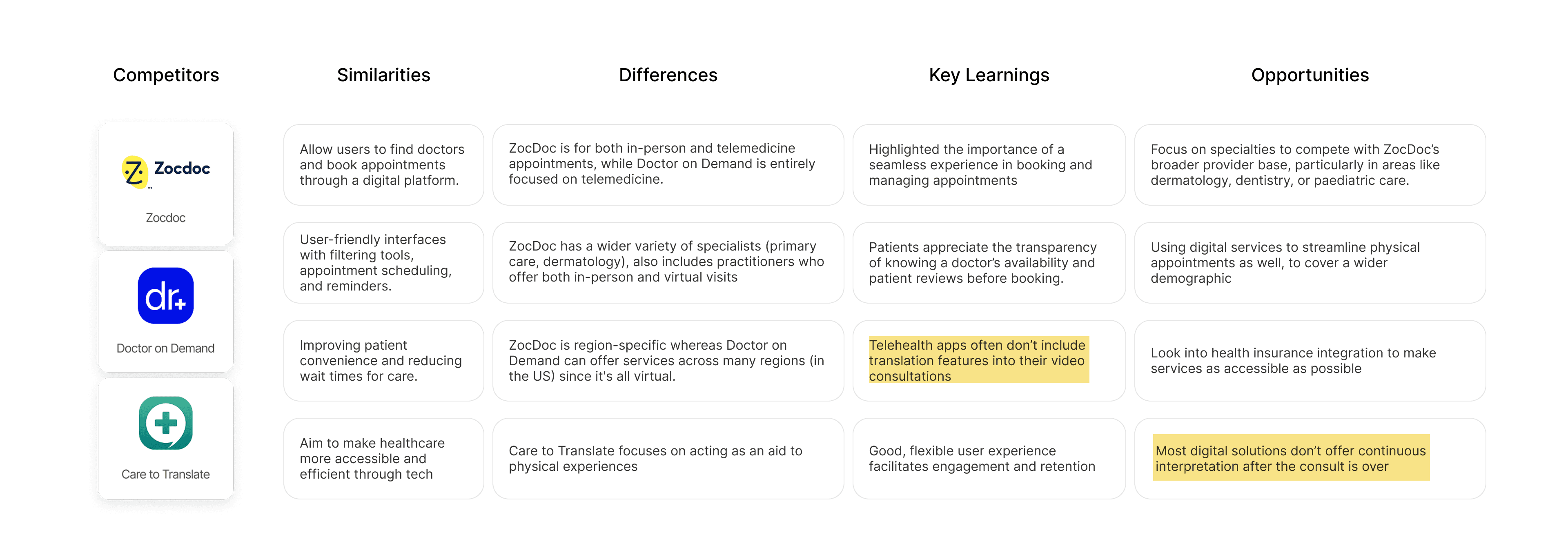
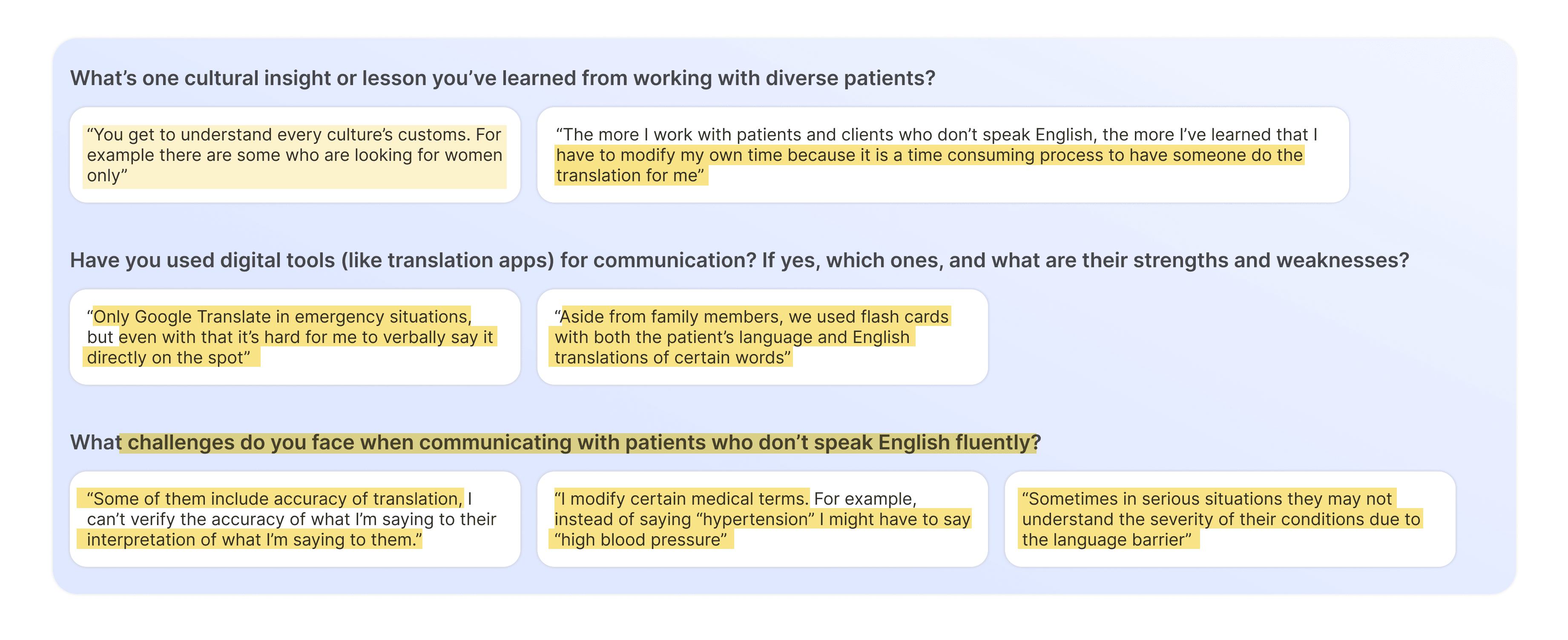
We used competitive analysis to compared pre-existing solutions and discover opportunities. Expert interviews helped us uncover user pain points and better understand the lens of healthcare practitioners.
Key Insights -> Action Items
Providers can’t verify whether patients truly understand critical information.
Design Implications: Designs should prioritize clarity, confirmation, and shared understanding, not just literal translation.
Language barriers prevent patients from understanding severity of their condition.
Design Implications: Critical information needs extra clarity, redundancy, and confirmation, especially post-appointment.
Medical language must be simplified manually by providers.
Design implications: Design for patient-friendly medical explanations that does not rely on clinician improvisation.

Narrowing down
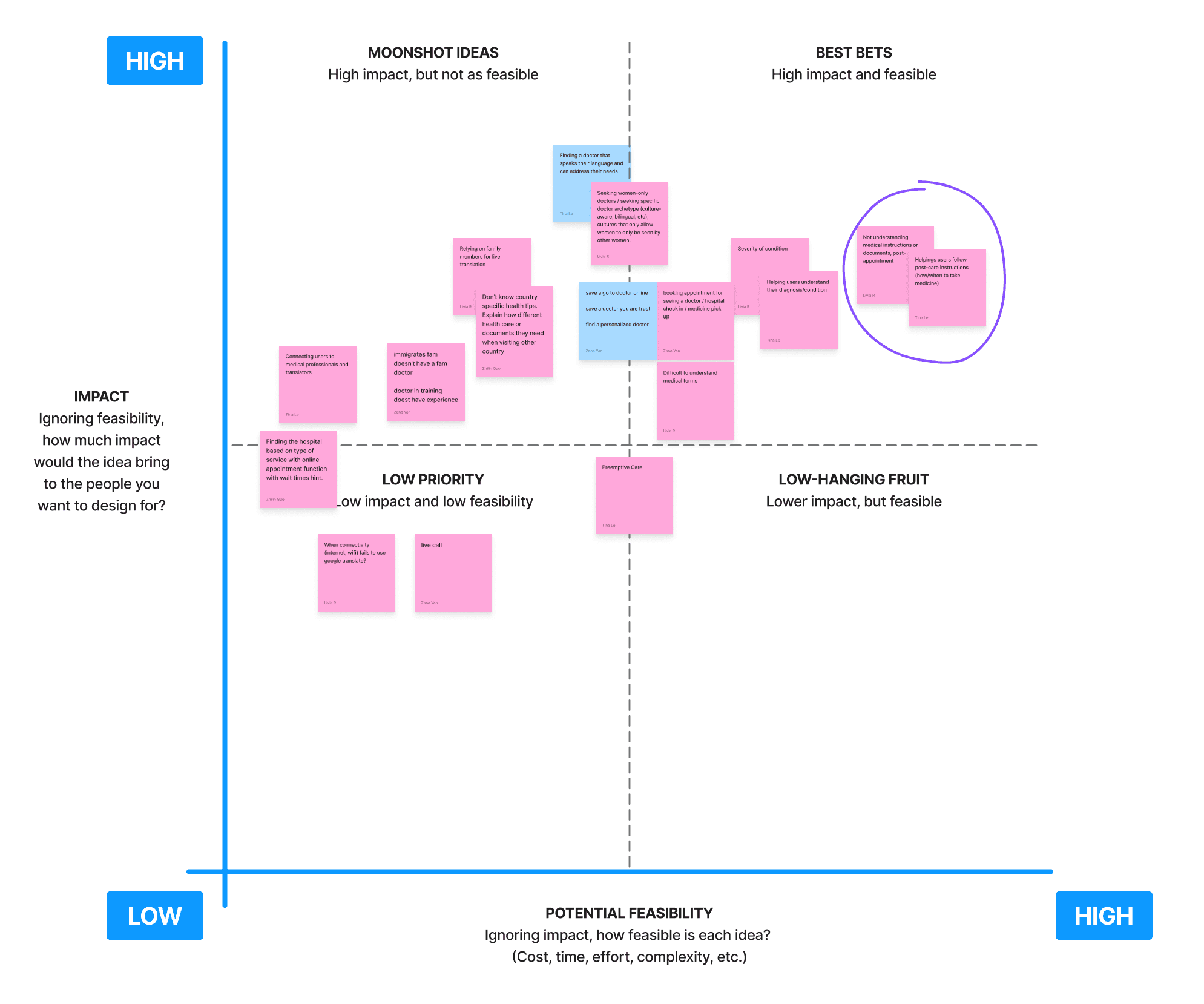
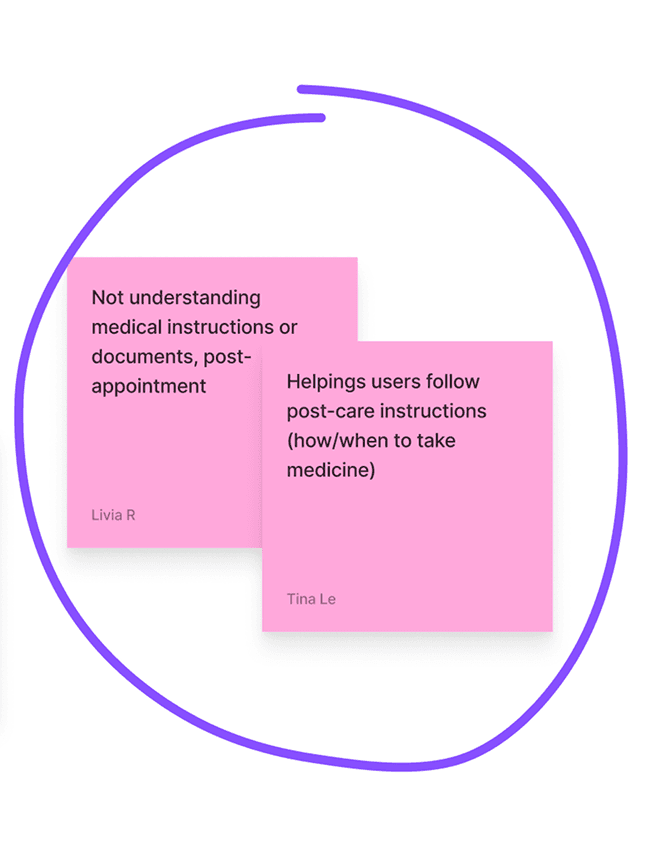
In order to determine the scope of MVP, we used the impact and feasibility matrix, and I led the team to determine one of the top features that should be built.
Design Goals and Constraints
We used constraints to limit the solution space in service of our design goals.
The design must include explicit confirmation mechanisms.
Summaries must be structured and chunked, not delivered as unverified translation.
Critical information must be redundantly communicated.
Location of tools must feel intuitive for clinicians and patients.
Success Metrics
We measure success based on users’ ability to identify the app’s core value and purpose right after onboarding.
Users are able to identify the core value of the app (UVP) and what the app can help them with (purpose) after the onboarding process
Users are able to immediately access and find tools (recording, language preference).
Summaries are clear and straightforward for the patient to understand.
Lo-fidelity Sketches
To get a sense and alignment of the core features to design, we turned our low-stakes Crazy 8s activity into Solution Sketches.
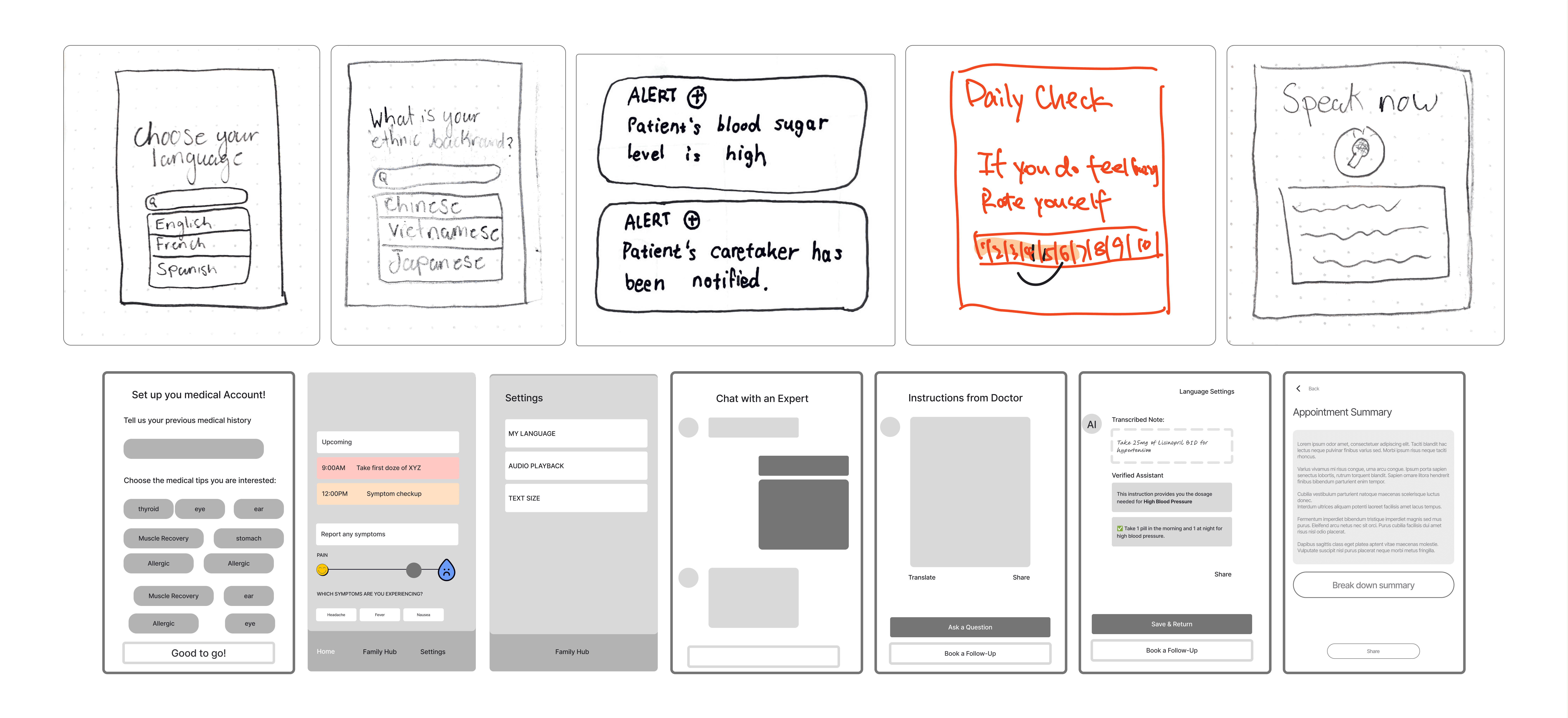
Early Feedback
After presenting our rough prototypes for critique, we received a valuable piece of feedback:
Your core features to prioritize should tie back to your problem statement and key learnings.
Mid-fidelity for testing
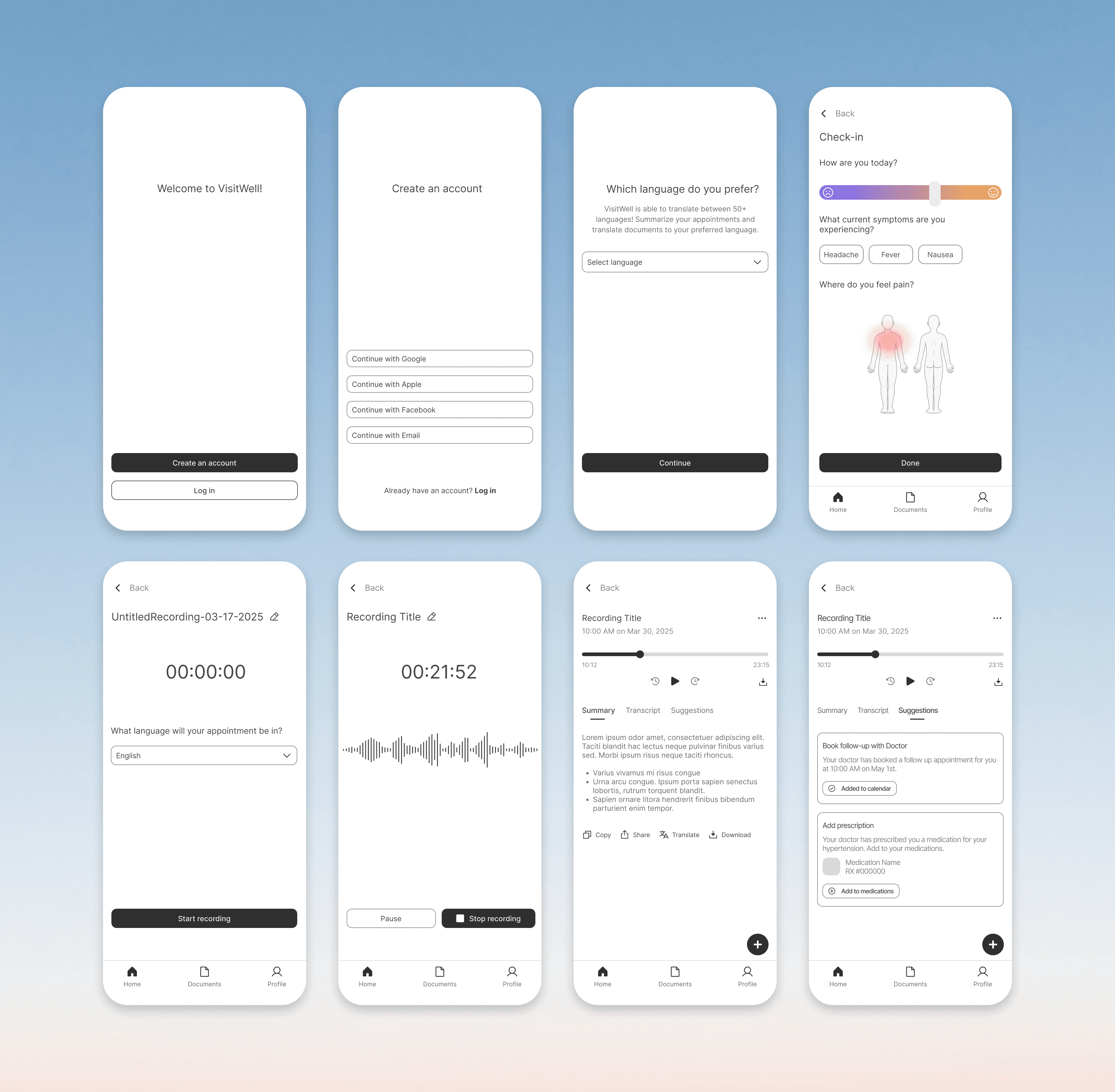
We focused designing a mid-fid version of three core features for user testing:
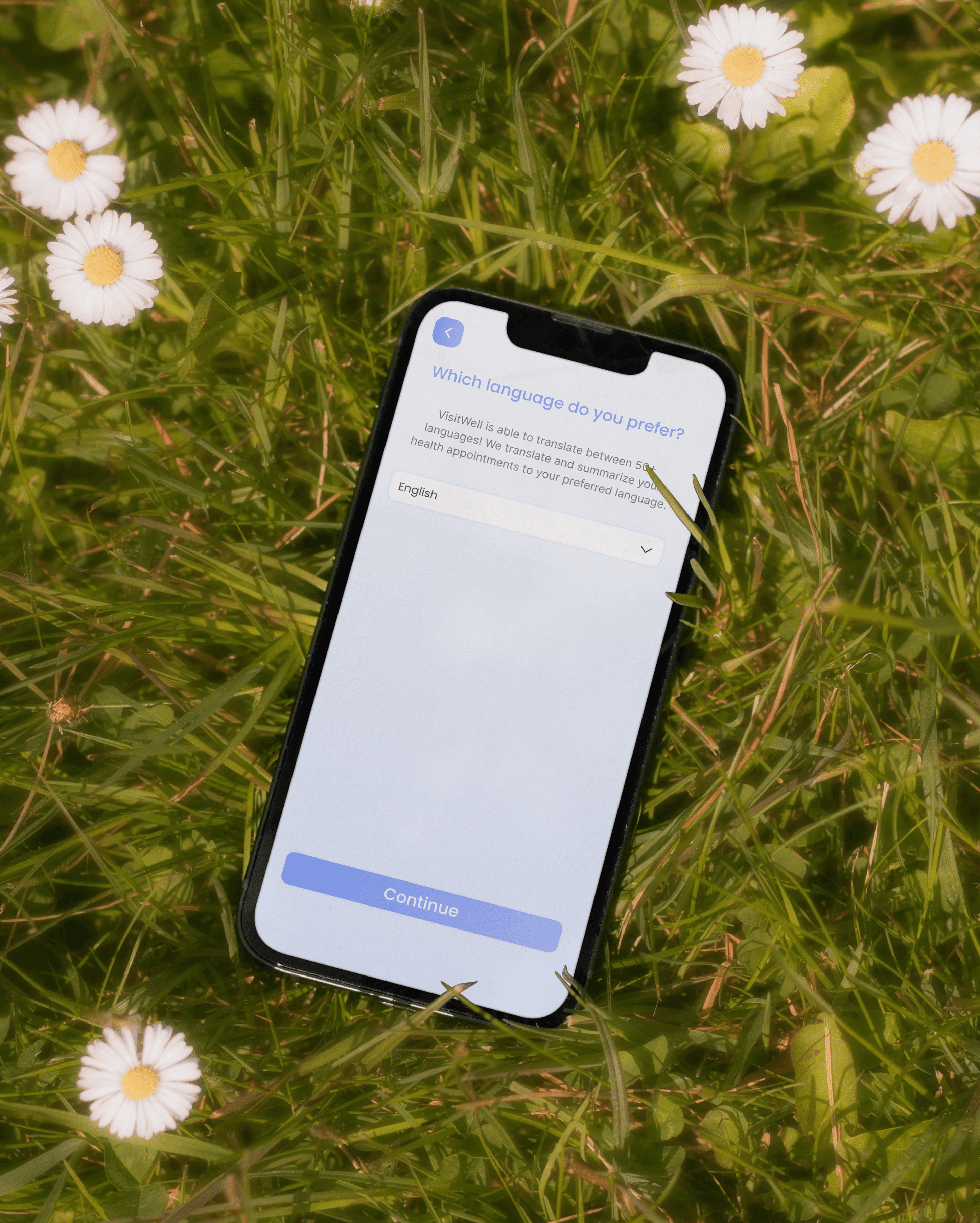
Onboarding + language setup
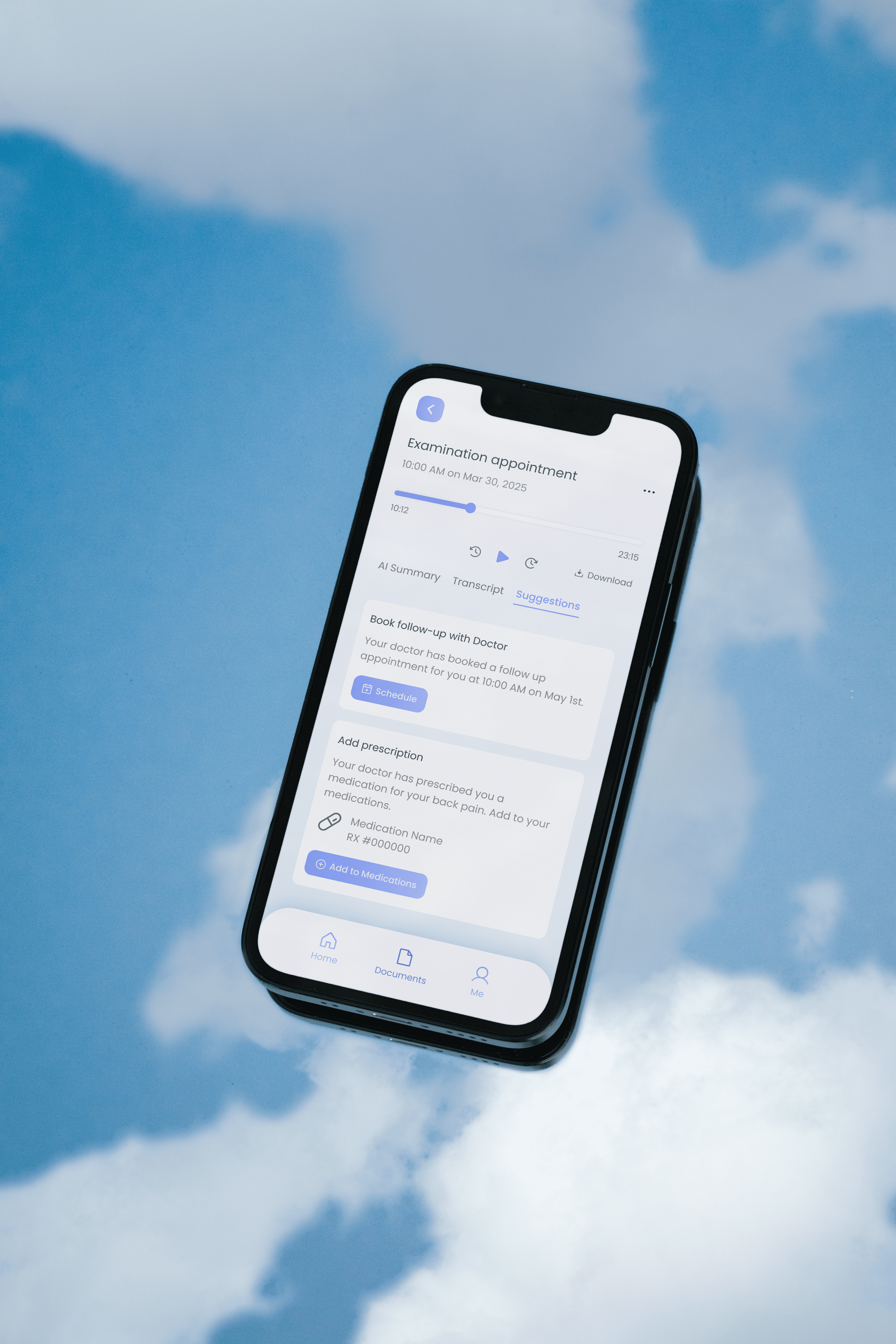
Recording / summary of appointment
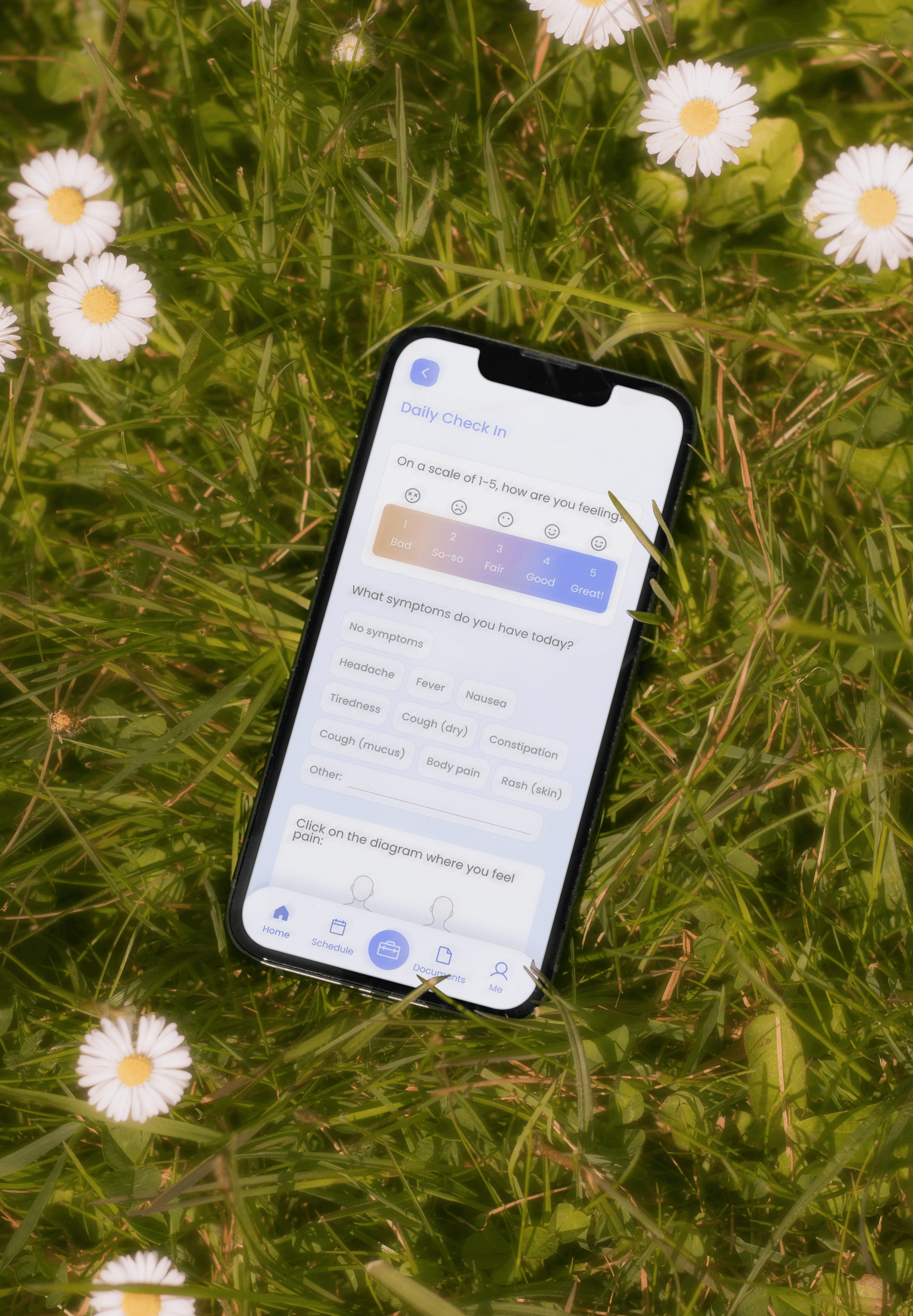
Pre-appointment check-in
Mid-fidelity Feedback
Onboarding + Language Setup.
Goal: Users are able to immediately understand the purpose and capabilities of tools available.
Results: Users are confused and assumed that the app helps users book appointments. 😞
Takeaway: The setup experience should focus on language setup when we’re committing to a patient-oriented app.
Pre-appointment check-in
Goal: Make it easy for HC providers to understand patient’s condition and prepare properly for them.
Results: Users feel restricted with options and vague feeling indicators.
Takeaway: Provide quick options for users to describe symptoms.
Recording + summary of appointment
Goal: Users are able to easily locate the feature and find it helpful.
Results:Users seem overwhelmed with too many options. Some are also looking for indicators of translation credibility.
Takeaway: Improve information hierarchy for options to reduce the noise. Allow for two-way communication between patients and HC providers.
Hi-fidelity Prototypes

Impact
Minimizing barriers of communication improves confidence for both patients and healthcare providers.
Increased confidence builds trust and encourages patients to attend more appointments.
Higher rates of access to healthcare services increases preventive care and treatment of chronic illnesses.
Reflection
If I had another shot in this project…
Quickly pivot the moment we started adding more features to the app—which doesn’t make it more appealing—to avoid diluting the core functions of the app.
I would put more emphasis in designing for a two-way communication between patients and healthcare providers.
I would position the app to be targeted more towards healthcare practitioners as the main target audience.